Blog

  • Relationship Advice for Small Businesses

    Relationship Advice for Small Businesses

    Image from Shutterstock

    At some point in my marketing career I became acutely aware of how marketers are conditioned to see India through an ‘outside’ perspective. These blogs are my effort to turn the tables, and dig into Indic mythology and scriptures in order to apply their wisdom to today’s marketing and business scenarios.

    In the last post we figured out online customer personas for businesses wanting to go digital. Today, let us explore the various relationship stages after the brand and consumer ‘swipe right’.

    While I am no relationship expert, but the following life advice holds true for both, traditional and digital businesses. We will now break away from convention and look at our business-consumer relationship through the lens of the four life stages in Indic philosophy.

    These are Brahmacharya (student years), followed by Grihastha (householder or family phase). Then comes Vanaprastha (retirement), and finally Sanyasa (renunciation).

    For ease of understanding, today’s example is inspired by a ‘non-chemical’ cosmetics brand I use regularly – Arata (this is not a paid post). This is a fairly nascent category that is still trying to gather critical mass. I will also try to keep things a little broad based for you to be able to apply the learnings to your own situation. I will also equate each life-stage with a business cycle stage. Caveats done, let’s start!

    cycle.jpg

    1. Brahmacharya – student years dedicated to learning the scriptures, worldly affairs and how to be a positive contributor to civil society.

    Business life stage – start-up – this is when the consumer first get to know of ‘chemical-free’ cosmetics as an option. Customers typically would do some online research, visit the company website, and speak to friends and family or even doctors who could tell them more. They then typically buy a safe, entry level product with low investment and usage risk.

    Why? Reasons for trial could vary from proactive pursuit of a healthier lifestyle, or a possible health scare which could make people clean out their chemical closets. it could also be demographics where an entire generation of consumers have come of age, or the new popular narrative fuelled by social media which is making people question their chemical products.   

    Life advice – behave like a gentleman and bring flowers on the first date (at the risk of sounding chauvinistic)! Approach customers with a brief introduction and how your business could improve their lives or be a solution. Answer all questions patiently, maybe even encourage them. Discounted trials and referrals from credible experts could go a long way at this stage to generate trials.  

    After all, the more they know about your business, the faster they will be able to make up their mind to commit.

    2.  Grihastha – the post honeymoon phase when life really starts. This stage of life is dedicated to building relationships, bringing up children and securing material security.   

    Business life stage – growth – this is when ‘chemical-free’ cosmetics are a lifestyle, and people understand the category and products better. They may also start checking out competitive options to see if they can do better. Possibly the business equivalent of the seven year itch, but this stage has the most potential of losing high paying customers.  

    Why? Possibly for reasons of variety or product dissatisfaction. It could also be that a friend has recommended or gifted them a competitive, or upgraded alternative.

    Life advice – keep your eyes and ears open for competition, new opportunities and also your own shortcomings. While the first two are easier, the toughest is spotting one’s own short comings. Consumers often don’t talk about gaps or dissatisfactions. The simply switch to other alternatives. Hence it important for brands to maintain a constant feedback loop with customers. This helps in upgrading and upselling products, aids new product development and innovation. This would also be a perfect time to introduce a loyalty program for repeat buyers.

    3. Vanaprastha – when active parenting evolves to becoming consultants and guides as grown children learn to figure out the world themselves.  

    Business life stage – maturity – by now purchase, consumption patterns and brand loyalties are fairly set. While this means assured sales, it also indicates stagnation.

    Why? Consumers use your products for specific purposes amongst other brands. This could mean they are probably nearing their ‘frequency of usage’ saturation point. There may also  have been life or cultural changes driving the category, like safer chemical cosmetics, changing requirements, cosmetic trends, or even more accessible permanent treatments.

    Life advice – start reading in between lines more carefully than ever! As an independent business owner you have a gold mine of consumer data, digital and social media trends. These should be able to tell you what consumers are searching online, new cultural trends, competitive developments, and pertinent lifestyle changes among other insights. This could shed light on product innovations, possible consumer touch-points and even tweaks to messaging patterns.

    4. Sanyasa – this final stage is of world renunciation. Kids are busy building their own lives and grandkids are life’s big joy.  

    Business life state – decline – when ‘chemical-free’ cosmetics are no longer a novelty and people feel these products no longer serve the purpose they once did. Consequently usage is decreasing and in some cases stopping altogether.

    Why? Well, for one, a particular product could no longer be required, or perhaps a superior product within the category has taken over. It could also be due to moving to safer and more advanced chemical based products or other specialised products for enhanced results.

    Life advice – first make a strategic call of wanting to continue the business or cutting ones losses. It is possible the business may have run their course and no longer make sense.  

    Alternatively, listen to what the consumers don’t say! Businesses need to keep track of even subtle changes in within their own category, competition and consumer behaviour also in related categories (like Ayurvedic and medicated cosmetics in this case). This could be a possible opportunity to reinvent the business itself to something new and more relevant.

    Conclusion – this lens of life-stages is applicable to both, business life cycles and customer relationship life cycles. However while businesses follow a set trajectory, relationships with customers can start at any of the four stages.  

    This framework should be helpful in slotting customers at various relationship stages so businesses can modify their behaviour accordingly. These relationships could last a single stage or start a cycle midway. By example, businesses lose many customers after a trial, but then a regular user (in the decline stage) may discover other or new products taking the relationship with the same customer to stage one!

    In addition to these life stages it is extremely important to work business development at all times. Only once you get prospective clients can you convert them into regular customers. However, always ask yourself and your customers ‘why’. Why customers choose your business so you know what you did right, and what you can improve. After all building relationships in the era of swipes is tough work. 

  • 2 Tested Ways of Inducting a Family Member into the Business

    2 Tested Ways of Inducting a Family Member into the Business

    Source: Study Cloud

    About 85% of incorporated businesses in India are family businesses – Times of India


    Welcome back dear readers. In this blog, we will examine the two most effective ways of onboarding a family member into the business.  This piece is based on queries by a few of you after the last blog on giving feedback to family members at work.


    Today, in addition to my own experience, I also spoke to HR onboarding and training professionals, and interviewed 5 second and third generation family businesses. I hope the result of the exercise proves useful for your own situations.


    So let’s get started with the example of twins Alia and Akshay. They have has just returned from doing their bachelor’s degree at a decent university abroad. Two weeks after settling in, they have are to join the family business. A fairly common story in most business families, including mine.

    Now there are two ways the twins can be groomed to take over. One, as an apprentice under the direct supervision of their father or uncle, or as a ‘management trainee’ within the organization. For the purpose of this piece, let’s assign (random selection) Alia to the apprenticeship model and Akshay to management trainee. Both are great hands-on approaches where one learns on the job, real time. Let’s discuss the apprenticeship model first.


    Apprenticeship Way –

    This is the more traditional way of inducting the family member. It is common for the next generation to finish formal education and join the family business. In this method they shadow a family elder, and learn the ropes directly from them (as they unlearn many concepts learnt at university).

    “
    “the older generation is sitting on an under-rated wealth of generational experience and wisdom which modern management and younger people need to appreciate. You cannot transplant western management in India”
    ”

    — third generation entrepreneur

    What works –

    Working directly with the top boss will give the Alia a front row seat to study the overall business and all its moving parts all at once. It is also the quickest way to induct someone and bring them up to speed to start taking responsibility and sharing the load sooner than later. The eventual transition becomes smoother within the organization and with external partners who interact with the family member over time and understand the succession plan.


    Where it falls short –

    To begin with, Alia would come with limited or negligible outside exposure. This would impact her ability to add value during critical decision making moments and consequently affect her self-confidence, and colour her perspective and thinking. Which in turn would influence any fresh innovation and evolution of the business. Additionally, because she started from the top, she will have limited understanding of the ground realities and operational nuances. She would need to rely on middle level managers for intelligence and information. Leaving her vulnerable to manipulation and being short changed. She will also inherit the pros and cons of her own conditioning of ‘this is how we have always done it’ mindset.


    Management Trainee Model –

    In this Ahshay would have a grown up discussion about his mentorship roadmap; training, role and responsibilities, and duration in each department and deliverables. The plan is to give Akshay a rotation and exposure to all departments before joining the top office to work as an understudy. He would have to start working ground-up, reporting to other experienced managers who are not family. Now let’s look at the pros and cons.

    “
    “the traditional family business setup is slowly warming up to the merits of a more impartial and holistic work experience for the younger generation. The world has changed at an unprecedented pace in the last fifty odd years”
    ”

    — talent recruitment specialist

    What works –

    To begin with being treated like any other employee, or as much as possible would help with grounding Akshay and hopefully tone down any sense of entitlement. Additionally, reporting to a seasoned expert or someone he is not related to would also provide a window of opportunity to learn the nuances and build professional accountability to an extent. This would also put Akshay directly on the front lines with others where he gets his hands dirty and learns from his own mistakes. By the end of the rotation, he would have a much better understanding of how the business works and be able to add value as he starts his training in the c-suite.


    What doesn’t work –

    First of all, this approach will not work for smaller businesses that don’t yet have different departments or functional heads. It would also not work for flat structures where the top boss is heavily involved in most aspects. Additionally, being the top boss’s potential successor means not only will Akshay not be able to escape his privilege, but will also be vulnerable to sycophancy and hidden agendas of others. Last but not the least, this is also a time consuming process. It’s not for those with less time or those who discount long term planning.

    Source: Vecteezy

    So which way does one choose?

    While both methods have their own merits and de-merits, it would be better to choose depending on the amount of time available to induct and the scale of business. Should the time be short or business not yet at the level with different departments, it would be most effective to go the apprenticeship route. However, if one has time, vision and scale, then the management trainee model would prove to be superior given the rigor, detailed understanding of all aspects of the business and time to get into the groove of things.

    So, if you are planning to join the family business, or planning to induct someone in, I hope this helps bring clarity and helps you make a more informed decision. Do write in and let me know how things go for you and if you would like me to explore any other aspects.

  • Creating “Online”​ Dating Profiles for “Offline”​ Businesses

    Creating “Online”​ Dating Profiles for “Offline”​ Businesses

    Image from GQ

    At some point in my marketing career I became acutely aware of how marketers are conditioned to see India through an ‘outside’ perspective. These blogs are my effort to turn the tables, and dig into Indic mythology and scriptures in order to apply their wisdom to today’s marketing and business scenarios.

    Today’s blog too will look a current topic of how smaller businesses are finally getting ready to make the digital commitment. This comes after years of eyeing digital from a distance and hesitating before committing to the inevitable. However, first, businesses need to be clear about ‘who’ their customer is.

    Romancing from a distance – hesitation of businesses

    This circling of one’s fate is not new. It reminded me of the part in the Ramayan when Ram and Sita first catch sight of each other in Janak’s (Sita’s father) royal gardens. They keep looking at each other from a distance and fall in love. They know they want to be together but need fate’s intervention.    


    Mustering the courage – making a digital move 

    Fate has intervened and now Indian businesses ‘need’ to go online to survive and grow. They can no longer delay making their move. Some neighbourhood stores are already experimenting with Whatsapp, as larger businesses plan their big digital weddings (no Zoom invites for these). In many family enterprises the younger generation is seizing the opportunity to digitise their businesses. Much like how sixteen year old Ram got his turn only after older kings had failed. 

    Facilitators of fate – dreams of digital growth

    However, even Ram needed Rishi Vishvamitra to convince King Janak to give the young prince a chance.

    Similarly businesses keen to go digital seek ‘matchmakers’ to fulfil their digital dreams. These digital experts promise snazzy websites, huge web traffic, eye catching ads, people clicking and buying, unimaginable scale and fame. These promises are backed by measurable, empirical data, which is digital’s big strength.

    However, it is important to not get carried away with the planning so much that businesses forget who the effort is for! 

    1. Understand what you want – digital customer groundwork

    Before the Swayamvar, Ram did his homework on Sita. He learnt of her birth and her qualities as a young woman. Sita on the other hand was smitten by the handsome prince in the park. Thorough homework landed Ram a dutiful wife, and Sita wound up in a forest. 

    Similarly, it is extremely important to understand your digital customer. There would be many more aspects to the person businesses have been dealing with offline so far.

    This is also the part of the job that cannot be outsourced. Even matchmakers ask people what they are looking for in a partner.

    So let’s look at some ways to make this critical job easier.

    2. Image of the ideal partner – building the customer imagery 

    Just as Rishi Vishvamitra painted the picture of Sita as the perfect spouse, businesses too need to build an ‘ideal customer’ profile. The traditional approach tends to list variables like; socio-economic strata, age, gender, geographical address, education… A typical customer profile would read like; SEC B, female, 25 years, postgraduate degree in computers, lives in Madurai, working for an IT company.

    This doesn’t tell us WHO she is, and why should she care about what your business.

    So let’s try a simple, step by step method of building a customer persona for an online sari business –

    – Step 1 – do you ‘know’ an actual person who could be your ‘typical’ customer? This could be someone amongst your own family and friends. It could be the vegan friend who is always looking for organic ingredients, the uncle with the ageing rock music phase ponytail, or the brand conscious cousin. 

    Agnostic of gender, age, race, this is about identifying a ‘real’ person who you want to go after. Depending on the type of business, this could work as an outline, or sometimes things fall into place at this stage itself.

    An online sari shop could want to target people like actress Rekha, or Anushka Sharma. This would be two very different sari clients. While one sports traditional weaves, the other is more contemporary and experimental.

    Example – let’s say we want to target Anushka Sharma


    – Step 2 – try using personalities. These could be celebrities, characters they play in their films or TV series, or even from a book. This helps giving an ‘attitude’ to the silhouette identified in the previous step.

    Our online sari store could go after one of the characters from a web series like ‘Four Shots More’, or a traditional Indian woman played by Jaya Bachhan in Kabhi Khushi Kabhi Gam.

    At this stage try to stay away from stereotypes, unless it adds a dimension to the character you are building.

    Example – our ideal customer is Anushka Sharma from When Harry Met Sejal.  


    – Step 3 – what does this person like? This is about granular specifics like; hobbies (music, gardening, reading), food preferences (Asian, Pizza, Indian), holiday destinations (beach, mountains, cities), other brands they buy (high-street, niche, organic), interests (traveling, yoga, trekking)… This helps round off the person in a little more detail and make the persona clearer.

    Example – Anushka Sharma from When Harry Met Sejal. She loves traveling, trying new food, movies and shopping.


    – Step 4 – what role would your product play in peoples’ lives? Can it solve a problem, or make life simpler? This is about ‘relevance’ and ‘rational’ reason to purchase, and not sales.

    By example, does your business save time, provide variety, convenience of click and delivery, assured quality? Or is it a wardrobe solution for a family function or office meetings? Or is it about region specific products, or propriety designs.

    This is when businesses start looking for, or creating the unicorn called the USP (Unique Selling Proposition). Reality is that most businesses are ‘different’ from one another but not unique. This step is about finding what differentiates your business from competition. 

    Example – Anushka Sharma from When Harry Met Sejal. She loves traveling, trying new food, movies and shopping. She is looking for a mix of traditional and contemporary saris for her wedding trousseau.   


    –  Step 5 – let’s look at the sociological or psychological needs your product could fulfil. This is the emotional gratification customers get so they can ‘justify’ their choices.   

    Does the product make them stand out, seem tasteful, show an appreciation of Indian weaves, or maybe project power in a boardroom?

    Trick is to avoid generic terms like happy, special, cheerful, pretty… It’s important to think of how you want to ‘make your customer feel’.  

    Example – Anushka Sharma from When Harry Met Sejal. She loves traveling, trying new food, movies and shopping. She is looking for a mix of traditional and contemporary saris for her wedding trousseau. She loves draping these in unconventional ways to make a statement while modernising tradition.  

    The perfect match 

    The above description is only one possibility in the digital world. More importantly, it is a starting point. Businesses can always add more details, refine and even redefine these personas basis various indicators.

    What is important is to pause a moment before making the digital move. Understand which kind of customer you want to target first. Once you know who you are looking for, communication touch points, occasions, messaging, media selection, results, all begin to fall into place. Almost like stars aligning for the perfect match as they did for the divine couple.

  • How to give to family members feedback at work: 3 rules for you can follow!

    How to give to family members feedback at work: 3 rules for you can follow!

    88% of Indian family businesses are poised for sustained expansion over the next two years, vs. the global projection of 77%. – PWC Family Business Report 2023.


    Welcome back dear reader. The last post was all about understanding how it’s possible to work with family and friends. Which led to enquiries about how one can give feedback to ones family without upsetting the personal equation. In this piece, we will examine how we can go about it.

    In order to write this blog, I have drawn upon my own experience of working with family businesses, and interviews with patriarchs who seem to have made it work, and some secondary research.


    To begin with, two big things to know and remember;
    One, you need to unlearn a lot of what management schools teach us. India works on a different cultural paradigm with its multi layered nuances. Nothing is linear and clear.

    Two, personal relationships don’t get left at the door. They need to be managed with a lot of wisdom and diplomacy.  


    One needs to remember both these things while giving feedback to family or friends at work. Let’s examine this in detail with a common scenario in Indian businesses – that of the next generation coming to work. Here, the father is the ultimate boss and the Heir is to be groomed to take over.

    Now, each successive generation will come with their own ideas (succession planning is another topic), start working, make mistakes, and learn. The big question is – who will bell the cat, and how? Let’s look at 3 basic principles that seem to have worked well for many people –

    1. Set clear expectations and outcomes – there can be no learning or feedback without measurable objectives. The Heir needs to be explained the role they play, the tasks they need to learn, who they would report to (some businesses avoid direct father-con reporting),  and how they are expected to conduct themselves. Some family businesses try to mimic the bottom-up, management trainee model followed by larger corporations for better overall grooming.

    The advantage here is that the successor, having grown up in the extended business environment understands the larger picture and objectives (subconscious osmosis) and has skin in the game naturally.


    2. Real time and constant feedback – this is something that most entrepreneurs say happens more by default than design. The personal equation and the desire to protect tends to overflow into the work sphere. So instead of trying to fight that instinct and neatly compartmentalise work and relationships, more experienced entrepreneurs use it advantageously.

    The trick is to give feedback behind closed doors, gently and firmly. The mentor needs to keep it specific, explain the context, action and correction. Very similar to helping with a math problem or teaching how to ride a bicycle. It is important to keep it objective to keep the flow easy for both parties.


    3. The BIG feedback – this is where modern management mixes with traditional wisdom. We are talking about performance reviews and tough conversations. These usually tend to happen when the loop of constant feedback and real time mentoring seem to fall short, or as routine in more formal structures. However, before these conversations, it is the family senior who needs to do most of the work.

    For these conversations, I have developed a PAT framework that will help the father make specific notes to keep things objective. Also, to give his Heir a ‘pat’ of encouragement after a year of hard work. The three aspects are Positive, Affirmative, and Transitioning. Notable is the absence of negatives. This is keeping in mind that the successor is typically there to stay. Therefore, it is more conducive to keep building and resisting the urge to criticise and having awkward overflows at home.

    Positives – it’s good to start the conversation with all the good that’s happened. One can discuss all that was learnt, what the scion liked, projects enjoyed, challenges faced, objectives met. This is like an informal warm-up chat to get the dialog going.


    Affirmative – this is when the chat becomes a little serious. This is when you discuss what didn’t go as planned, what they learnt, any plans to handle the situation/project differently, to avoid the same outcome. At this point just listen, and understand the other person’s point of view. Idea is to avoid making them feel defensive, so they don’t shut down.


    Transitioning – this is where a father’s temperament, patience, and instinct to be a little harsh, are all tested. The feedback needs to be specific with examples to illustrate the point. This will keep the conversation on track and avoid getting personal.  


    One needs to objectively approach set KPIs and achievements, behaviours that need alteration, address the Heirs’ role in projects that didn’t go well, or feedback from other departments. This is also a great opportunity to understand where the next generation is heading or thinking for the business.

    PAT Frame work – proprietary of Brand Couch

    Let’s try and simulate a possible dialogue to see how one can give feedback. (You may skip the role play below and head to the conclusion too) –


    P(arent) – So H, how was your year at work? I have heard good things about you from other people. People/I was impressed with your work on X project. Tell me about your experience?

    H(eir) – …

    P – I was proud of how you handled B challenge and conducted yourself well at D occasion.

    H – …

    P – What did you learn from the experience?

    H – …

    P – So what do you think you might do differently next time in a similar situation?

    H –  …

    P – I feel things could improve if the next time you handled (specific) situation in these (specific) ways. I have made the same errors and learnt. Doing it in a particular way will help avoid conflict/ losses/ embarrassment.

    H – …

    P – Looking at the objectives we set for you, you have met some/most of them. Let’s look at the gaps and discuss how to fill them. I want to remind you that this is about the work, and not you personally. We can do this together.

    I have made a list basis the KPIs and objectives set and what didn’t go as per plan. One area is on project M. These are the two challenges that came up. I would be interested to hear your perspective and thinking on these.

    H – ….

    P – There is also some general feedback from other people that I just wanted to air and hear your perspective and plan for ahead. We can discuss what is fair or unfair and find solutions and make changes.  

    H – …

    P – You have done well and I am proud of you. Let’s keep working as per our plan and see what else we can make possible.


    Now, the above conversation is only to illustrate a possible flow, and not prescriptive. There are multiple variables that could alter the course of even the most well intentioned discussion. There are relationships dynamics, the emotional investment in the aspects discussed, who they are discussed with, the temperament of the family members involved, etc.


    To conclude, giving feedback to family or friends at work is tricky. One needs a mix of compassion, patience, diplomacy and professionalism. Before the conversation, one should make clear notes about specific incidents, behaviours and examples on how to improve and change. These notes will enable constructive and clear feedback without getting personal. The PAT framework is designed to set a positive tone and gradually move to things that the person themselves realised could be done better, to wider feedback and course correction.


    While working with family is never easy, I hope this article an framework sparks off ideas and helps you find ways of making things work in a positive manner where everyone is happier. The thing to remember is that it is about the work, not the person.


    If there is any aspect of working with family and friends you would like me to discuss here, please do write to me or comment below. I look forward to hearing from you and seeing how we can make things work better.


    The author is a brand & business clarity coach and marketing consultant who helps businesses and entrepreneurs get unstuck, get clarity and unlock growth. He works mainly with independent businesses and entrepreneurs to help them optimise their thinking, behaviour patterns, and marketing efforts. To know more, visit brandcouch.co/.

  • Inherited Antibodies of Indian Entrepreneurs

    Inherited Antibodies of Indian Entrepreneurs

    Image from Istock

    60% of B2C Indian start-ups are facing closure as per Nasscom survey

    Reading such news in the papers is disheartening for people who birthed ‘jugaad’ and embody the essential spirit of entrepreneurship, that of overcoming and circumventing all systemic and social discouragement.

    The Indian Entrepreneurship Dream may seem sick but it has everyone rooting for its recovery. This time, not from cheap substitutes, but a mass disseminated virus from the across the same border.

    In this piece we will explore how Indians subconsciously draw on their ‘cultural inheritance’ as they intuitively fight for their businesses.

    However, before we start our journey let us not underplay the importance of cash in keeping a business running (about 40% start-ups are considering shutting down) but instead, look at mental fortitude and strength that keep an entrepreneur going.

    These times remind me of another existential crisis that possibly left the Indic psyche with strong antibodies that last generations.

    Last big existential crisis

    Yes, I am referring to the conversation between Arjun and Krishna on the battlefield of Kurukshetra. The finest warrior of his time lowered his bow refusing to fight the most important battle of his life, overwhelmed with existential angst. His charioteer and guide Krishna persuaded him otherwise. The rest is of course history or mythology.

    Inherent immunity and Indian entrepreneurs

    So, let us look at some existential questions Indian businessmen are possibly dealing with in these times. What follows is a combination of secondary research and conversations with businessmen and start-up entrepreneurs across a variety of sectors.  

    Paralysis in crisis – just as Arjun was paralysed with immense fear that made his bow fall from his hands, Indian businessmen were caught by surprise with the virus and its consequent lock-down.

    Inherent immunity – instead of panicking, most entrepreneurs used the pause to look at the larger picture. Used to systemic setbacks, these unfazed warriors took some time out from constant fire-fighting, reflected, and drew up contingency plans. While social media congratulated them on their Master Chef potential, they were calmly planning their post-lock-down moves.  

    Compassion and karma – Arjun was overcome with compassion for his relatives and teachers who he would have to fight and possibly kill. Similarly, most businesses have avoided lay-offs as much as possible.  

    Inherent immunity – instead they deferred or cut salaries reserving the biggest reductions for themselves. They unconsciously followed the ‘businessman dharma’ by protecting their employees the best they could, even at personal cost.   

    Lay-off carnage – Arjun questioned any joy arising from the hollow victory after killing his own kin, subsequent loss of cultural heritage and not having anyone left to celebrate with. Similarly, business people and HR professionals have expressed deep anguish at layoffs.  

    Inherent immunity – businesses fired employees sparingly as possible. People have tried to hold on to senior, or founding employees to preserve the organisational culture and ethos expecting to rebuild new teams with the same values.  

    Krishna’s persuasion

    Krishna proceeded to give Arjun an extensive discourse on existential philosophy to persuade him. Below, are some take-outs that I felt could be helpful for businessmen –

    – Don’t be afraid or act from a place of fear – Krishna tells Arjun to proceed fearlessly for he has nothing to worry about.

    Similarly, this is a time for bold decisions that businesses may have been avoiding. This re-boot has given people opportunity to take those chances.

    By example, Cult Fit started online exercise and yoga classes when physical gyms were locked down. While the loss of revenue is real, they have embraced technology and the possibility of reaching people and places remotely even after things open up.

    – Perceived identity and realities keep changing – Krishna told Arjun those he considered his friends today could well be his enemies tomorrow. There are no fixed realities and identities. Only our mind that puts them in certain contexts.

    Similarly, businesses should not be afraid to re-think their core business, business models, or delivery models. An idea can live in different forms much like a soul changes the physical body.

    By example, Zomato has already applied for alcohol delivery licenses across states. Retailers have embraced video calls for a virtual retail experience and mobile payments.

    – It is better die gloriously in war than run away like a coward – Krishna reminded Arjun that his duty as a warrior (Kshatriya Dharm) was to fight, not run away.

    Similarly, the undying spirit of entrepreneurship calls for not surrendering to systems and circumstances.

    Shutting businesses is always painful; like killing a dream, or a child and losing a part of oneself in the process. A closure shouldn’t be in surrender but a glorious fight with no regrets. Possibly even a strategic retreat so entrepreneurs may live to fight another day, maybe in another form.

    To conclude – businessmen and professional existentialism are no strangers. An entrepreneur perseveres and overcomes self-doubt, naysayers, red-tape and other set-backs regularly. However, very few get a moment to wonder about the inexhaustible spring of cultural inheritance that’s guides them subconsciously.   

    Krishna-Arjun existential discourse is possibly one of the many sources of wisdom we draw upon in crisis. For now, let us remember to act fearlessly, do the right thing, and have the discrimination to choose what to preserve and what to let go, as we re-think, reinvent, and re-emerge from these times. The meek may inherit the earth, but they never rule it. 

  • Working with family and friends? Let’s make it work!

    Working with family and friends? Let’s make it work!

    Source: Hindustan Times

    Welcome back dear entrepreneurs. Allow me to pick up where we left off. In the last post we discussed when a business partner was really needed. In this post we will analyze the possibility of that business partner being family or friends.

    The concept is a tried and tested one. While some come from business families, and some want to  break away with changing times, others dream of building their own dynasties (usually with friends, late night, after a few drinks, and holiday planning).

    To begin with, let’s look at the 2 critical reasons why working with family and friends is so common and why it works –

    1. Cultural similarities – you share similar values, views, and preferences. This means people would generally follow a similar code of ethics, values, thinking and working styles. This makes it easier to communicate thoughts and ideas, and smoother work dynamic, especially in the early stages where everyone has to pitch in. By way of generalized example, entrepreneurs from Punjab are known for their bullish enterprising spirit, while businessmen from the trading communities are known for their measured understated restraint.

      The downside – could be the lack of diversity in thinking which could mean fewer differing perspectives which are needed in a competitive business environment. What also tends to happen is that the person with the least say or stake often tends to be overlooked or go unheard even when they may have valuable inputs – sowing seeds of discontent in the long run.

    2. High levels of trust – people are most invested if they have their skin in the game. After all, we don’t think our own family member or close friend with betray us or do something that will harm our joint interests. This has been exemplified with some of the largest business houses in India being family enterprises that have evolved to accommodate growing family members.

      The downside – oftentimes we find people ill-suited for a role in critical functions. They could be the top boss’s eyes and ears on the ground, or because the management doesn’t know how to fire or reassign a family member or friend without upsetting the personal dynamic.  


    We now know the two major reasons why working with family and friends works, and where it can cause friction and complications. To avoid these, and to ensure that work doesn’t go home, and vice-versa, I recommend an easy two-stage process to my clients –

    1. Boundaries – one needs to establish clear areas of operation, ideally with the effort to train or place people basis their qualification, interest and aptitude – like at any other job.

    This ensures efficiency, effectiveness, and growth opportunities for the individual. It also results in lesser operational overlaps and conflict, and fewer opportunities for other work partners to exploit a fault line within the family or friendship.

    2. Conflict resolution mechanism – some form of disagreement is inevitable, despite establishing clear boundaries. Given the delicate nature of personal relationships, one needs to be doubly careful.

    I recommend clients to have the tough conversation about the various scenarios and what would need to be done as and when they surface. Depending on the scale of the business these could be done with the help of an HR expert, an external guide or in person.


    The big pay-off – you get to keep your business and your relationships. Over the course of research in addition to my personal experience, the biggest regret and learnings entrepreneurs had was having to choose between work and relationships. Invariably losing both, or feeling like they lost both even if they managed to hold on to one of the two. Working with family and friends is trickier than hiring external talent and developing deep bonds over time. However it does not need to be an either/or situation. I do believe, in this case at least, people can have their cake and eat it too.

  • Why Gen-Z is Forcing a Management Style Reboot

    Why Gen-Z is Forcing a Management Style Reboot

    Image from Revenue-hub.com

    With this generation of workers respect cannot be ‘demanded’ nor taken for granted, but earned!

    While in the last post we looked at what Gen-Z consumers expected from their brands. In this post we will shift the lens to the managers at these corporations. So, let’s explore together how this set of professionals might just make managers adjust to them, instead of the other way around! 

    Same yet different

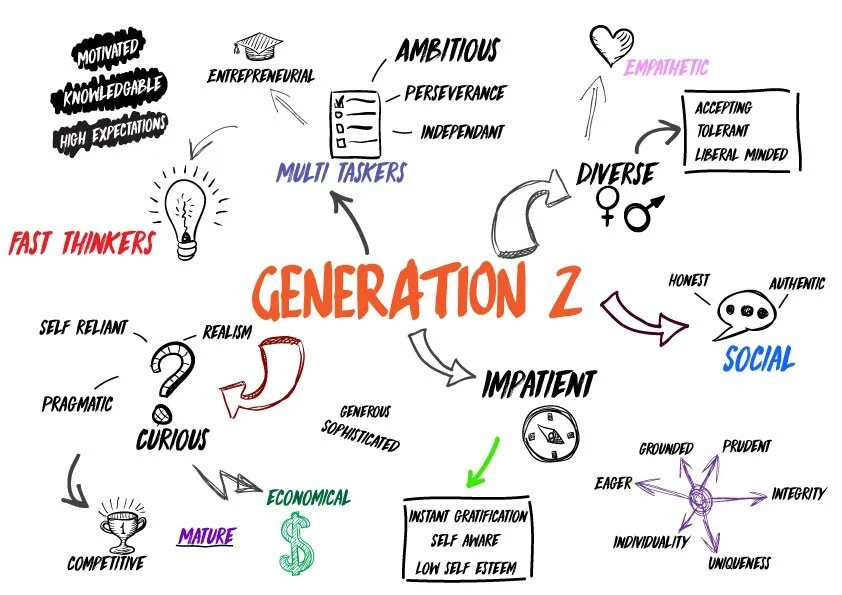
    So we know this generation is more like a software upgrade from the Millennials. These Gen-Z 18-25 year olds have similar social and cultural values as their predecessors, but take things a notch further. Gen-Z has graduated from the Millennial social media outrage to actively trying to change what they don’t like.

    The deviation tends to become more apparent when they exchange protest arm-bands for suits. Gen-Z has come of age through an economic recession and a planet past the ‘save-by’ date. Being made to clean up after the previous generations’ hedonism and denial of it’s impact, has made Gen-Z practical and pragmatic in some ways.

    Gen-Z pragmatism

    A recent study by Deloitte tried to verify general impressions about Gen-Z formed over time by blogs and other studies. Below are some hypothesis they confirmed –

    – Pragmatic professionals – they want financial security and not particularly looking to do what they ‘love’ like the Millennials

    – Shop-in-shop work model – they prefer being entrepreneurial within the safety-net of a stable environment unlike the start-up Millennials

    – Individual workers – this generation prefer being individual contributors but not isolated unlike team player Millennials

    – Work for brands they like – they prefer working for brands and organisations they interact with in their personal lives

    – Value sharing – quality product and service is a given. It’s the company’s core values and ethics that this generation want to connect with

    Of these, the last two stood out for me. While brand familiarity might bring these workers through the doors, a shared value system would be needed to retain them.

    Currency of authenticity

    Now, one look at the management legacy of the retiring Boomer managers (50-60 year olds) and the people they have trained, and you can almost see Trouble! This generation seems short on patience and are not afraid of ‘calling people out’ on their double standards, platitudes and inaction.

    By example, Unilever was forced to drop its ‘colourist’ products, albeit in name only, and closer home young people are downgrading Tik-Tok with nationalistic fervour. 

    Gen-Z is ‘demanding’ authenticity and they don’t seem to be in a mood to stop until they force a management reboot.

    Seeking authenticity in leadership

    So this naturally leads us to investigate ‘authenticity’ in the leadership context. Here I have tried to explore three parts of authenticity –

    1.      Transparency – this generation wants to know why they are doing what they are doing, what impact it will have on the world, if it’s the right thing to do. They want to know where they fit into the scheme of things.

    Implications – managers need to be upfront and clear about what they are asking these professionals to do, given them the entire big picture instead of just telling them to follow

    2.      Responsibility and accountability – this generation has a different concept of hierarchical distances within an organisation. They are not afraid of speaking up, asking tough questions and holding people accountable irrespective of seniority.

    Implications – managers stand to lose the ‘immunity of seniority’ that they enjoyed with previous generations. Gen-Z will no longer let their managers get away unquestioned. Possibly even bordering on how children hold their parents accountable when asked to ‘do as they are told’ and not ‘as they are shown’.

    3.      Vulnerability – this is a big winner with Gen-Z. This generation acknowledges that it is only human to make errors. Their problem lies in denial, shifting blame, and not fixing whats broken! Admitting mistakes is not something associated with older styles of leadership where getting any kind of apology is akin to pulling teeth. The younger people acknowledge that people make mistakes.

    Implication – managers who put aside their ego and admit their mistakes find their teams more than ready to help them fix things. The old-school managers who stand stiff break with the wind as their own teams allow them to take the fall they deserve.

    To conclude, I think it’s safe to say that the era of the ‘tough boss’ who was above reproach is coming to an end in the board rooms. 

    Gen-Z want managers to be honest and transparent with them about, not just their role in the larger scheme of things, but also their larger impact. They seek accountability and someone who is not afraid of admitting their mistakes and fixing things when they go wrong. 

    As the corporate world readies to welcome a new generation of professionals, it is perhaps for the first time that new entrants are re-writing the management rule-book for their managers.

  • 4 times when business owners need a partner or co-founder

    4 times when business owners need a partner or co-founder

    Source: Bentley University & Shutterstock

    “I need a business partner. I really think I do…?”  

    This is becoming an increasingly common topic of discussion during business counselling sessions with entrepreneurs. Many feel having a co-founder or partner is just the way to go, while others wonder if it really is a mandate given most of the Unicorns and recent success stories seem to have at least two or few hands on deck.

    While statistically it is tough to determine if a business will do better with a partner, there is a lot of data that suggests about 70% of business partnerships fail (that’s for another blog). Having said that, having a business partner does have its advantages like; sharing the risk, workload, moral support, and more.

    So when a client comes wanting to figure out if they need or want to take on a co-founder or business partner, we use the BEAM model to get arrive at the answer. I am sharing it here so it may help anyone of you out there –

    BEAM Model (R)

    1. Business development and access – a founder or business owner eventually exhausts their family and friends as initial customers quickly. This is when a partner may be able to introduce the brand to an entirely new set of customers. These could be from a different geography, social set, psychographic or socio-economic set otherwise untapped or unavailable earlier.

      Possibilities – many businesses engage with business introducers with a basic plus incentives model, or for specific geographies, or a sales head with limited ‘sweat’ equity basis performance, depending on the product or service in question.

    2. Expertise/ skill gap – this is usually a good reason to take on a partner. Not everyone is good at everything. Many people have the capital but don’t know how to use it, other times you may have the talent or expertise but lack the finances to take off. Subject matter experts are usually a good way of plugging a gap.  

      Possibilities – check if you can hire someone, or need a co-founder to work with a team. Having someone who a deep understanding of an area is usually worth giving up control and equity for the sake of sure and deliberate growth and success. Many founders explore the option of ‘sweat equity’ in exchange for the skill brought on board.

    3. Action gap/ work load sharing – this is for business owners who get overwhelmed by the unending to-do lists and things that need to be done by one person. Since most people are not superhuman, they sometimes take on a partner to ensure stuff gets done!

      Possibilities – have clear task and professional boundaries, and a plan to resolve any conflicts arising from the occasional overlap. This is when people typically bring on sales or operations or HR heads with a stake to incentivise performance.

    4. Money / capital – the fire power behind all the talent and ideas. Today’s ‘idea economy is brimming with ideas, enthusiasm, experience and expertise. What one needs is a bit of money magic to get things moving.

      Possibilities – the funding ecosystem is evolving quickly in India with multiple options like Angel Investors (think Shark Tank), Venture Capitalists, Crowd Funding, Private Equity, Debt Financing and then some. The source of finance depends on the business needs, the founder/owners willingness or comfort with parting control or ownership depending on the nature and stage of the business and its valuation and profit potential.


    To summarise, it is not necessary to have a business partner or co-founder. Having one comes at the cost of control, equity and freedom. If you do want to engage, the BEAM Model should be helpful in making sure you do it for the right reasons and not because you feel you should or because someone told you so. After all, it is your business shaped by your vision and decisions. The buck does stop at you.

  • What Do Over 2 Billion Gen-Z’ers Want From Brands?

    What Do Over 2 Billion Gen-Z’ers Want From Brands?

    Image from Medium.com

    “Gen Z expected to make up for 32% of the global population, with India’s Gen Z population crossing 472 million” – Bloomberg

    Organisations have always struggled with trying to know what customers ‘really’ want from them. I too have worked long and hard on trying to uncover and understand consumer motivations, insights, trying to read in between lines of what is said and meant by consumers.  

    However, what happens when the customer DOES tell you what they expect from brands. The new customer may still not be clear about what they want from products. However, they do know how they want their brands to behave in the real world.

    When I say ‘real world’, I mean the changed eco-system of target consumer and values they hold dear. These key characteristics change for each generation and marketing follows suit.

    For this piece let’s look at the how Marketing Managers might be able to ‘get the pulse’ of their new customers.

    The NEW customer

    There has been a change of guard amongst the Marketing heads. The ‘Boomers’ (roughly 50-60 year olds) known for cut-throat marketing and management as we know it, are retiring. They are being replaced by the Millennials (roughly 28-35 year olds) who are said to be less hard-nosed and more work-life balance oriented.

    However, what stays the same is the bloody competition to woo the new big consumer set. In this case, Gen Z (roughly 16-25 year olds). This set is a natural evolution of their predecessors, like a software update. They picked up where the previous generation left off and are pushing the boundaries on all fronts. For this piece I have drawn on my own research experience and the latest MTV Youth Study.

    Gen Z Software upgrade

    So this generation is more online, more connected on social media, more into gaming, more fame pursuing (reality show stars to social media influencers), and yet more pragmatic about not needing to like their jobs to make money… They are more ‘human values’ driven and are vocal about them.

    Gen-Z has moved from the Millennial arm-chair activism of Facebook statuses to being more ‘active’. They have moved from ‘wanting change’ to actually ‘making the change’ happen. This is generation WOKE, and expect their brands to be too!   

    Generation ‘WOKE’

    The single biggest observation of this can be seen with the race and gender equality protests in the United States. Maverick ice-cream brand Ben and Jerry’s was applauded for speaking up against ‘white supremacy’. Other brands came under fire for fence sitting or not speaking up.  

    Closer home, the Indian youth has been most ‘vocal for local’ as they call for a boycott of mobile phone applications and products from our hostile neighbour. They have also called out Bollywood on its nepotism and bullying like never before. This has resulted in actors and directors losing hundreds of thousands of followers within days, lawsuits being filed, petitions being signed for audience boycotts…

    WOKE Brand Leadership

    In such times, any brand not ‘woke’ enough risks being alienated or becoming irrelevant. I have tried to list some values that businesses would need to share with their with new consumers –

    – End the tactical ‘brand hustle’ – many Brand Managers try to ‘cash-in’ on social media topicality. They don’t realise that this opportunism costs the brand its ‘authenticity-creds’ with Gen-Z.

    It takes effort, consistency and a bit of daring, to build and sustain ‘Amul’ kind of communication.

    – Authenticity – this generation holds brands accountable for their actions, i.e. putting their money where their mouth is. Gen Z seeks authenticity from their brands given they have been saddled with cleaning up after the ‘Boomer-Millennial’ party.

    By example, competitor shoe brands Adidas and Allbirds are collaborating to come up with lowest carbon footprint shoes. Unilever has decided to ‘carbon label’ all their products to demonstrate a shared concern for the environment and climate change.  

    On the flipside, Starbucks’s ban on employees wearing t-shirts protesting racial discrimination had to be reversed and replaced hastily with specially designed t-shirts.    

    – Inclusion and progressiveness – this is the most inclusive generation, embracing diversity of race, gender, sexuality, equality, and forcing brands to take a stand.

    By example, the ripple effect of racial protests in America, led to Clean-n-Clear stop selling fairness products in Asia and Middle East. The Indian ‘dark is beautiful’ campaign, fashion shoots and TV commercials with ‘dark skinned’ women, all reflect the social change.    

    – No more shaming – while the ‘Boomers’ may call this generation ‘overly sensitive’, the truth is Gen-Z are more self-aware and vocal about issues that no one ever spoke about; body image, skin colour, sexual preferences, bullying, exam pressure, poverty… This is a generation that ‘shames the shamers’.

    Zomato’s tweet in response to a customer’s demand for religious discrimination among delivery personnel went viral for all the right reasons. One potentially lost customer was rewarded with greater brand loyalty among Gen-Z.  

    – Vulnerability – this is a BIG one! Gen Z doesn’t want excuses. They understand people and brands can make mistakes and occasionally slip-up. What matters to them, is that Brands own up to them and ‘fix’ things.

    By example, Facebook’s Cambridge Analytica scandal and BP’s oil spill (mis)management and subsequent apology could be case studies of ‘how not to’ apologise.

    On the other hand, smaller brands tend to be more honest and upfront with their consumers. Perhaps, because they are closer to them than large brands. By example, Indian home décor start-up, The Wishing Chair sensed their customer’s underlying vulnerability and anxiety during Covid-19 and started a newsletter with content to help distract them.    

    To conclude, the Brand and Brand Manager teams are navigating unchartered territory. The consumer is well informed with unlimited access to information and the means to disseminate it. Smoke screens, lack of transparency, vagueness, opportunism doesn’t work with this generation of consumers. They clearly seek brands that share their ‘human’ values; authenticity, vulnerability, and inclusiveness. It is therefore, imperative for Brand Managers to think ‘as’ the Brand and do the ‘right thing’. After all, what’s a relationship without honesty. 

  • Imposter Syndrome – The Secret Battle

    Imposter Syndrome – The Secret Battle

    Source: zoho.com

    “Once they realise I am not the star performer they think I am, they will fire me!”

    If you have ever had similar thoughts, or are waiting to get ‘caught faking it’, read on dear reader. Today, let’s discuss the feeling of being the pretender in the room – the IMPOSTER SYNDROME

    The syndrome

    In simple words it is the feeling of ‘not being as good as others think’ – aka the imposter or pretender, or the ‘faking it’ kind.  Most people usually chalk it down to low self-esteem or lack of confidence. The self-doubt is more common than anyone would imagine amongst entrepreneurs and top level executives. Only no one talks about it! 

    Telling signs

    This syndrome was common to quite a few of the clients I worked with. It was something we both discovered as we worked on something else entirely. So as we move forward, let’s see how many of these factors you identify with –

    –         Think people will find out you are not as good as they think you are

    –         Feel you don’t deserve the success, or promotion or increment

    –         Have difficulty accepting compliments or credit for work well done

    –         Lack confidence even though you know, and are good at what you do  

    –         Think you have been mostly lucky (even though you work hard)

    –         Keep waiting for your ‘streak’ to end

    –         Feel you will get caught faking it! 

    source: verywellhealth.com


    The consequences

    This feeling of constant insecurity manifests itself in many ways. The most common being overthinking, over preparing and reluctance to try new things. While over preparing can be beneficial when trying to grow the business, or seek funding, the other consequences can actually have a counterproductive effect like –

    –         Constant stress and anxiety – the impending sense of doom, the perpetual waiting to get caught. Physically this typically manifests itself as stomach churn or knots. This could have health implications like irritable bowel syndrome too and nervous twitches.  

    –         Decreased effectiveness and feelings of isolation – the constant wait for doomsday and life to end means one spends more time thinking up worst case scenarios vs. productive work. This also manifests itself in wanting to keep to oneself in case anyone else catches on. This could lead to paranoia, depression and actually believing ones negative thoughts to be true!   

    –         Reluctance to try new things – people tend to stick to what they know works. Also, trying out new things entails trying and failing before succeeding. The process feels like it will expose the achiever to be a fraud. As a result most people end up self-sabotaging themselves and their work to avoid getting caught. 

    Source: thedataincubator.com


    What can people do –

    I will not tell people to keep calm and carry on. Instead this is something to be addressed. The anxiety is a combination of feeling ‘physically unsafe’ and ‘emotionally vulnerable’. The entrepreneurs or professionals needs to convince themselves at both levels that they are not imposters. There are some simple steps I use in my sessions.

    1.      Make a list of what makes you qualified for the job – this includes qualifications, experience, unique personality traits that make you suitable for the job and set you apart from others. You could even try looking up the internet for people with your unique set of qualifiers. You will realise that you are indeed one in a few thousand at least!

    2.      List accomplishments – make a list of all the awards you have won, appreciation e-mails from clients, funders, even school teachers and certificates from that time. You can store these as a folder on your system, or keep a journal. Essentially anywhere you can revisit them and own your success!

    3.      Make realistic goals – while everyone wants to be a Unicorn, or the next Steve Jobs, understand that not everyone will. Not making it to the page of a magazine cover does not make anyone less successful. You need to define your own parameters of success which are realistic, achievable and tangible. It is great to aim big, but do it in small steps vs. giant leaps.

    4.      Avoid the Jones’s – stop looking at peoples perfect lives on social media and networks. No one puts up stories of their failures or struggles (unless seeking attention). We end up comparing our worst selves to peoples’ best – not fair is it?

    To sum it up –

    It is natural for all of us to feel we are not as good as people think we are. The roots of it could lie in various factors and conditioning. These feelings are also not perpetual or constantly in the foreground. These have triggers. It is important to look out for those. However, what is more important is to learn to deal with these lest they become self-fulfilling prophesies. So the next time you feel like an imposter, look at your list of qualifications and accomplishments and how far you have come. Once you do, the knot in the stomach should dissolve and will hopefully relax those shoulders and bring a real smile to your face – not a fake one.